The Unwritten Middle: Reading the Transitions That Science Prose Compresses

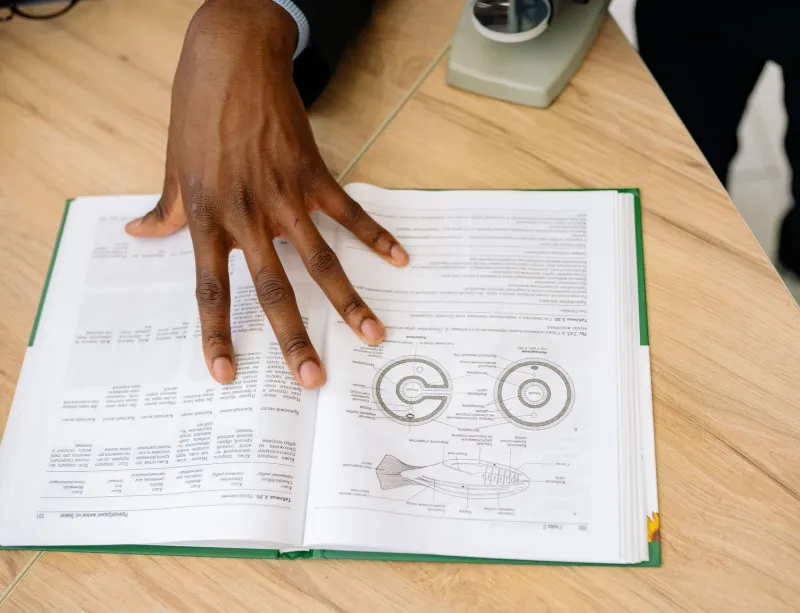
Photo: student annotating science textbook with pencil classroom UK secondary school, via static1.bigstockphoto.com
A GCSE physics sentence can look complete and still ask the reader to do a great deal of work. Consider an illustrative line from a textbook: 'The resultant force on the object is zero, so it continues at constant velocity.' The words are plain; the grammar is ordinary. Yet the 'so' is not a decorative connective. It is a hinge on which a whole principle turns. A pupil who has not yet secured Newton's first law will read the sentence as a statement of fact rather than an inference, and the explanation will pass them by while appearing perfectly clear.
This is the quiet problem of compressed reasoning in science prose. Textbooks, revision guides and examination-style answers frequently use transitions — 'clearly', 'obviously', 'hence', 'therefore', 'it follows that' — to move swiftly from premise to conclusion. For the expert writer, the step may indeed be small. For the novice reader, it may be the whole lesson. The issue is not that science writing should become laborious. It is that compression, left unexamined, can turn reasoning into assertion.
The hinge in the sentence
Transitions do two jobs at once. They signal logical relationships, and they make judgements about difficulty. When an author writes 'clearly, the rate increases', the adverb is not a neutral signpost. It tells the reader that the connection is supposed to be available without further comment. Sometimes that is fair. Sometimes it is a polite fiction. Either way, the word can discourage a pupil from asking the question that matters: what exactly has been assumed here?
In science texts, the omitted middle often contains one of several familiar moves. A definition is being applied. A causal mechanism is being invoked. A mathematical relationship is being rearranged. A boundary condition is being taken for granted. A diagram is being translated into words. The transition conceals which move is required, and a reader who cannot name the move cannot rehearse it.
Why fluent readers stop noticing
Experienced readers are poor judges of their own fluency. A teacher reading 'the solution is acidic, therefore the pH is below 7' may see a simple application of a definition. A pupil may see two statements joined by a word that sounds like a instruction to agree. The teacher's expertise fills the gap so smoothly that the gap becomes invisible. This is not a failure of subject knowledge. It is a failure of noticing what subject knowledge has done.
That matters for classroom practice because many pupils do not lack the will to read. They lack a way of seeing where the text has asked them to supply a step. Words such as 'obviously' can be especially misleading. They imply that a lack of understanding is a lack of attention. A pupil may conclude that the problem is theirs alone, rather than a feature of the text's compression.
What pupils hear when they read 'clearly'
In a classroom, the word 'clearly' can function as a closed door. It does not literally prevent questions, but it changes their social meaning. To ask 'why?' after 'clearly' can feel like admitting that one has missed something everyone else has seen. The same is true of 'it follows that', which presents the next sentence as a consequence already earned. Pupils may copy the sentence without acquiring the inference, and the copied sentence will look like understanding on the page.
This is why vocabulary support alone will not solve the problem. The difficult words in science are often visible and can be glossed. The difficult moves are carried by common words, and they are easy to overlook precisely because they are common. A glossary entry for 'osmosis' does not tell a pupil how to read the sentence that applies it.
Rebuilding the middle: four classroom moves
One useful approach is step expansion. Ask pupils to rewrite a compressed sentence as a short chain: premise, principle, conclusion. The illustrative physics line might become: the resultant force is zero; Newton's first law says an object with zero resultant force keeps a constant velocity; therefore the object continues at constant velocity. The rewritten chain is not better prose, but it is a better scaffold. It makes the omitted premise available for inspection.
A second move is to interrogate the hinge. Replace 'clearly' with a question: 'Clearly, the enzyme is denatured.' becomes 'What evidence would show that the enzyme is denatured?' This turns an adverb into an inquiry. Pupils can then look back at the data, the graph or the method section rather than accepting the writer's confidence as proof.
A third move is to ask pupils to mark the compression. Give them a short passage and invite them to underline every transition that hides a step. Then ask them to write the missing sentence in the margin. This is a small routine, but it teaches a durable reading habit: transitions are not decoration; they are places where the text has done work on the reader's behalf.
A fourth move is comparative reading. Place two explanations of the same idea side by side — one compressed, one expanded — and ask pupils to identify what the second text supplies. The aim is not to prefer wordiness. It is to make visible the choices writers make, and to show that an explanation can be concise because it assumes a reader, not because it contains no reasoning.
The limits of unpacking
There is a risk of overcorrection. Science writing needs compression. A textbook that spelled out every premise would be unreadable, and examination answers must be efficient. The point is not to ban 'therefore' or to treat every adverb as a conspiracy. The point is to teach pupils when compression is safe and when it is doing too much. Expert readers skip steps because they can reconstruct them. Novices need practice in reconstruction before they can skip with confidence.
That practice belongs in subject classrooms, not only in literacy sessions. It requires science teachers to read their own texts as novices might, and to notice the places where their expertise has quietly filled a gap. It also requires a classroom culture in which asking 'what happened between these two sentences?' is treated as disciplined reading rather than slow reading.
A reading culture, not a vocabulary list
The 'obviously' problem is not really about a handful of adverbs. It is about the unwritten middle of science prose: the definitions, principles and inferences that writers leave for readers to supply. When those steps remain invisible, pupils can mistake fluency for understanding and confidence for evidence. When they are made visible, pupils gain something more useful than a corrected sentence. They gain a method for reading any explanation that moves too quickly, and for asking what the text has asked them to assume.
Science in Reading is interested in that kind of reading: not the performance of sounding scientific, but the patient work of following an argument from one sentence to the next.