Where the Argument Points: Reference Chains in the Science Classroom
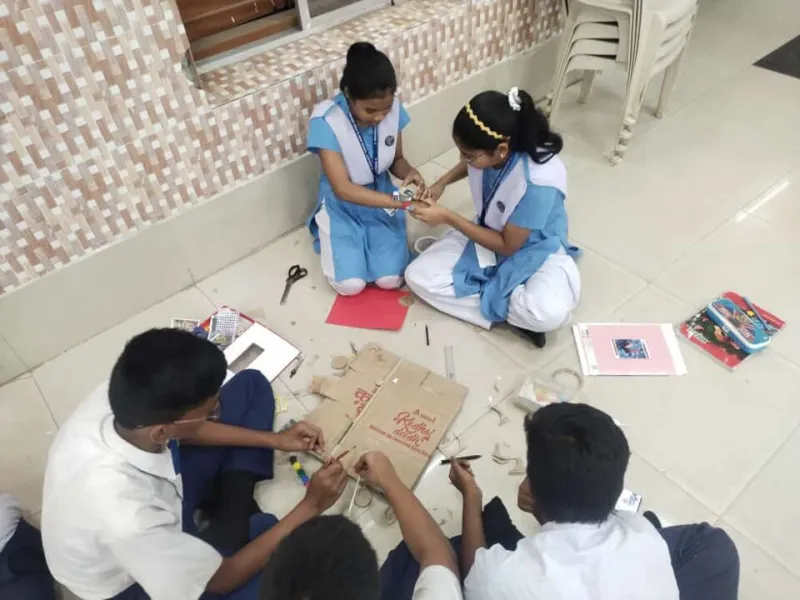
Photo: Kritish Mohapatra, CC BY-SA 4.0, via Wikimedia Commons
In a science paragraph, meaning rarely sits still in one sentence. It is carried forward by small words: 'it', 'this', 'they', 'these', 'the former'. These words are easy to overlook because they are grammatically ordinary. Yet in science prose they do serious work. They tell the reader which object is being heated, which variable is being compared, which property explains a phenomenon. A pupil who cannot resolve them may decode every word and still lose the argument.
Consider a familiar explanation of transpiration. 'Water evaporates from the leaves. This creates a tension in the xylem. It draws water up the stem.' The word 'this' does not simply point back to evaporation as a topic. It points to an event and its consequence: the loss of water vapour creating tension. The word 'it' then refers not to the leaf or the xylem alone, but to the tension. A reader who attaches 'it' to the wrong noun will misread the mechanism. The science has not failed; the reference chain has.
Reference is not a grammar chore
In many classrooms, reference is treated as a matter of grammar: pronouns must agree, 'this' must have a noun, 'they' must have a plural antecedent. Those conventions matter, but they are not the point. In science reading, reference resolution is part of comprehension. It determines whether a causal claim attaches to the right entity, whether a data statement refers to a mean or a category, and whether a conclusion follows from the intended premise.
This is why a worksheet asking pupils to circle pronouns is rarely enough. Circling 'it' does not require the reader to decide what 'it' is doing in the explanation. A more productive question is: what would change in the science if 'it' referred to something else? That question moves reference work from labelling to interpretation.
Three places where reference carries the science
Method and apparatus
Practical writing is full of compressed reference. 'The residue was washed and it was dried' leaves the reader to decide whether 'it' is the residue, the filter paper or the apparatus. In a method section, that ambiguity can obscure procedure and, in some cases, safety. Pupils writing up a required practical often produce sentences of this kind because they are managing several objects at once. A brief reference check, asking them to replace 'it' with the intended noun phrase, can make the procedure clearer and the science more secure.
Data and interpretation
In data discussion, reference often carries comparison. 'The counts were higher in the shaded quadrat. They were also more variable.' Here 'they' may refer to the counts, the quadrats or the conditions. 'The former' and 'the latter' create similar demands in comparative sentences. When pupils read tables and graphs alongside prose, they must track whether a referring word points to a category, a value, a trend or a treatment. Misresolving 'they' can turn a statement about variability into a statement about abundance.
Mechanism and explanation
Explanation is where reference matters most. 'The membrane is partially permeable. This explains why only some substances pass through.' Does 'this' refer to the membrane, to partial permeability as a property, or to the whole preceding fact? The distinction is not pedantic. It decides whether the pupil explains a structure, a property or a relationship. Similarly, 'therefore' depends on a resolved premise. If the reader has attached the preceding 'it' to the wrong entity, the conclusion will appear to follow from the wrong claim.
A short routine: the reference audit
A reference audit can take two or three minutes inside an ordinary reading episode. Pupils read a short paragraph and pause at each referring word. They then ask three questions. First, what noun phrase or clause could replace the word? Second, does the replacement preserve the science? Third, is there more than one plausible candidate? The third question is often the most useful, because it reveals where the text is genuinely ambiguous rather than merely difficult.
Teachers can model the routine with a think-aloud. Read a sentence such as 'The current increased when the resistance fell, and this was expected.' Pause at 'this'. Is 'this' the increase in current, the fall in resistance, or the relationship between them? A pupil who says 'the increase' and a pupil who says 'the whole event' may both be partly right; the task is to justify the choice from the surrounding science. The point is not to hunt for a single grammatical answer, but to make the reader's inference visible.
From tracking to explaining
Once pupils can track reference, they can use it to build explanation. A useful follow-up is to ask them to rewrite a paragraph so that every 'it' and 'this' has a clear referent. This is not an exercise in avoiding pronouns. It is an exercise in deciding what the explanation is actually about. In a UK classroom where curriculum time is tight, such rewriting can serve both literacy and science: the pupil must name the entity, the process or the relationship that the original text compressed.
Reference chains can also be mapped visually. Pupils draw an arrow from each referring word to its antecedent, or to the clause it summarises. Where an arrow is uncertain, they mark it with a question mark and discuss it. This makes the invisible work of reading visible. It also gives teachers a quick assessment of whether pupils are following the mechanism or merely the topic.
What teachers can do tomorrow
Model one reference resolution per paragraph, not every one. Choose the word that carries the most science. Ask pupils to distinguish between reference to a thing, a process and a relationship; 'this' often points to a process or a whole clause rather than a noun. Include occasional assessment questions that ask pupils to identify a referent and explain how the science supports their choice. Finally, treat ambiguity as part of the text, not as a pupil failure. Some science sentences are genuinely under-specified, and noticing that is a reading skill in its own right.
Small words are load-bearing. Teaching pupils to resolve them is not remedial grammar. It is teaching them to follow an argument from sentence to sentence, and to see where the evidence, the mechanism and the conclusion actually point.